Showing posts with label Allium. Show all posts

Monday, June 01, 2009

Cool Blue Garden

Camassia ~ a favorite early bloomer ~ delicate, star-shaped flowers.

It's been raining. A lot! Which is very odd in a high plains desert and that's inspired a few Midwestern Moments. Been gettin' all reminiscent about those wasted years when I lived in Minnesota. When most every outdoor plan we'd have was foiled by bad weather.

Dainty little Brunnera (flowers the size of your fingernail) lays claim to a shady spot in my yard.

Back home it's okay to bitch about the rain. Rains every damn time you get on your bike. Out here, it never rains (or so they say) and so I have to keep my trap shut.

The bluest and latest blooming of my Lilac Menagerie has a wonderful fragrance after the rain.

But it has inspired a cool, blue mood in my garden.

The crazy hairdos of Centaurea Montana

It's hard to find true blue ~ especially at my place since my alkaline soil does it's level best to change everything blue into purple and pink. (Acid soil does exactly what I'd like it to do but I'm not moving back to Minnesota to achieve this goal.)

Here's the latest gamble I planted with fingers crossed I might see true blue:

These Gladiator Alliums are supposed to be deep blue/purple, not pink. And, they're supposed to be 6-inch diameter flower balls (as opposed to 3 inches.) But, I still think they're kind of cool.

* Aluminum Sulphate or pine needle mulching are other ways to make your soil more acidic. Though it hasn't worked all that well for me...

Thursday, November 06, 2008

The Case for Heirloom Bulbs

Powerscourt Gardens, near Dublin, Ireland. I took this photo 20 years ago and I'll bet younger generations of this same Tulip bulb are still blooming.

"Your bulb order is heading to the barn and from there it will be shipped."

I got all warm and fuzzy when I heard my bulbs were heading to the barn. I hoped there were horses in that barn. Maybe even a cow, or two.

How cool would that be if it was a real barn and my bulbs were resting on a big wooden table instead of bouncing down an automated conveyor belt and into a box?

Whatever the case, that barn comment stopped my bitchiness dead in it's tracks. I called to demand where my order was. Mountain snows are just around the corner. I'd like to dig up a little more dirt before that happens.

When my precious bulbs finally arrived I stood at the fence and proudly showed off my purchase to my neighbor. She stared at me in disbelief. How can you possibly have a Hyacinth bulb from 1863?

Then I showed them to my daughter who laughed out loud and promptly asked to borrow some money.

I walked out to the garden shaking my head. Must everything require education?

I mean... really. How could my own daughter be so dumb as to think I'd loan her money after she mocked my gardening passion?

It makes perfect sense to me why we're confused by heirloom bulbs. It's because we've grown up gardening with hybrid bulbs.

Hybrid bulbs are cheap! So, we buy a bunch of them. They don't last very long. So, we go buy some more!

Hybrid bulbs don't reproduce.
Most flower for a few years. Soon their flowering power dwindles or they stop flowering altogether.

Heirloom bulbs eagerly reproduce.
These bulbs split in two. So 10 bulbs quickly become 20 and soon you have a garden filled with pretty spring flowers. They're tough, they last forever. In the long run they're less expensive than hybrids.

Most importantly, heirloom bulbs, like heirloom tomatoes, got voted off the island by big stores simply because they weren't as profitable. Now you know how much you love a good heirloom tomato. Imagine how exciting an heirloom Hyacinth could be.

Long live the MasterCard! Here's my bulb order:
  1. Grand Monarque Hyacinth, born 1863
  2. Purple-Headed Garlic Allium, born 1766
  3. Marjolettii Tulip, born 1894
  4. Rip Van Winkle Daffodil, born 1884
  5. Spanish Bluebell, born 1906
  6. Gipsy Queen Hyacinth, born 1927
  7. Princeps Daffodil, born 1830
  8. Orange Phoenix Eggs and Bacon Daffodil, born 1731
  9. Estella Rijnveld Parrot Tulip, born 1954 ~ which is probably not truly an heirloom. Unless we can call Wunx an heirloom, too. (What say you to that Wunx? :))

Wednesday, May 02, 2007

Long-Blooming Perennials

I work hard for a living and my flowers should, too. That means nixing lazy perennials that think they can get away with a bloom time of 4 weeks or less. (Slackers with the name Day Lily need not apply.)

These high altitude work horses flower 8-16 weeks with minimal care. All are drought-tolerant, much-loved by hummingbirds and butterflies.

Johnson's Blue Geranium
Geranium himalayense x pratense
Flowers: May - September
Full Sun
USDA zones 4-8


Redbirds in a Tree
Scrophularia macrantha
Flowers: June - September
Happiest at 6,000 feet or higher
Full to part sun, shield from wind
USDA zones 5-10


Cat Mint
Nepeta x faaseenii 'Select Blue'
Flowers: June - August
Full to part sun
USDA zones 4-9


Jupiter's Beard
Centranthus Ruber
Flowers: June - August, with deadheading
Full to part sun
USDA zones 4-9


Corkscrew Ornamental Onion
Allium senescens 'Blue Twister'
Flowers: June - September, with deadheading
Full to part sun/Loves clay soil
USDA zones 3-8


* Tip: Some of the most spectacular perennials bloom for very short lengths of time. Plant them among these long-flowering varieties for continuous color all summer long.

Sunday, November 12, 2006

Allium Species Bulbs

My garden is my gym, my playground and my church. It also serves as a wildlife sanctuary, a bird aviary and a butterfly brothel. But, as of today, it's closed for the season.

Great timing! On the last good gardening day I'll see for six months, my Allium Bulbs arrived! I had just finished planting them when snowflakes began to fly.

Allium 'Hair' (above) is just like it sounds. These odd, hairy flowers are a real attention-grabber in the spring garden. Bloom time is about 3 weeks, 24 inches tall, USDA zones 4-8.

Allium 'Fireworks' (above) stand about 12 inches tall, raining bright purple, yellow and white flowers in late spring. Great for rock gardens.

Give Allium 'Unifolium' (above) room to spread. They naturalize beautifully, creating a pretty drift of star-shaped, pink flowers.

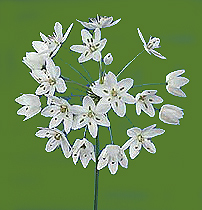
Allium 'Cowanii,' or Allium 'Neapolitanum', (above) has been around since the 18th century. These 16-inch tall, graceful bloomers naturalize quickly. Divide mature clumps in late summer, when they become overcrowded.

Alliums range in height from 6 inches to 4 or 5 feet, depending upon the variety. Rodents can't stand the onion fragrance of these bulbs. And, that's a good thing because this is one bulb that won't double as lunch for the pesky, little critters who patrol my garden.

They're easy to grow and particularly nice for xeric landscapes since they like dry soil, when dormant. Plant Allium 3 times as deep as each bulb is in diameter. Deep planting is important because it keeps the taller plants from drooping under the weight of the flowers.

PS: Ever been stumped on which end is up? Sometimes it's hard to tell top from bottom with strange bulbs. When in doubt, plant bulbs sideways.