Showing posts with label fall bulbs. Show all posts

Wednesday, October 14, 2009

283 Bulbs + 5 Blisters = High Hopes 4 Springtime

Up Close & Personal with a Tulip

Final tally: 283 flower bulbs.

Those 3 extra Tulip bulbs traveled from Amsterdam to Park City, Utah ~ stowaways in Sandy's suitcase. And, I was ever so grateful.

I planted those special 3 in the center of a HUGE circle of Daffies and Allium bulbs. In the high hopes that this bad-smelling bulb strategy might outsmart the infernal critters snooping around for tasty tulips.

Jonquils and Hyacinth

I went a little hog wild this year. Ordered most of them from the same company. Imagine how delighted that company must be, assuming all sorts of future profits from this big spender bulb-aholic!

Alas, they will be sorely disappointed. This was a one time deal simply because I was lonely. I traveled the entire month of September. Realized I was missing my gardens when I found myself pulling weeds at our cabin on the Oregon shore.

That inspired me to busy myself on the airplane, writing a great big bulb order.

Now, I assume you know the do's and don'ts of great big bulb orders, right? Send it off immediately! Before you have the good sense to think about the cost and all that hard work. :)


This one's for you, Jan!

Perhaps this is the needlepoint pattern I should try my luck at this winter?

That could take me 'til April and beyond... :D

Saturday, September 22, 2007

Heirloom Hyacinths

Delft Blue Hyacinths
(Not an Heirloom)
This hybridized Hyacinth is available just about everywhere.

I wish my friends could be a little more thoughtful (and be born in various months during the year.) Six of them are celebrating birthdays, this month, right about the time I would selfishly like to spend all of my money on fall-planted bulbs. :) According to the stars, Librans (that would be me) aren't even supposed to get along with worry-wart Virgos so I've no idea how I've accumulated so many!

Of course, there's lots of things I don't know. Like the fact that bright-blooming Hyacinths are being hybridized to extinction. I discovered that while I was roaming around Google this morning, trying to find some birthday presents.

At one time, Hyacinths were more popular than Tulips. And, for good reason. They bloom longer, are much hardier, and fill your spring garden with an intoxicating, sweet perfume.

Rare Hyacinth Bulbs:
* I'm buying mine from Old House Gardens. They specialize in heirloom bulbs. It's my first purchase, so I can't recommend them. But, I do admire their love of odd bulbs.


General Kohler: Born 1878
The oldest, surviving double Hyacinth.


Marie: Born 1860.
One of the rarest. Now considered 'commercially extinct.'


Gypsy Queen: Born 1927.
Naturalizes 'effortlessly' in dry, southwest gardens.


Hollyhock Hyacinth: Born 1936
Blooms later in spring than most commercial Hyacinths.


Curing the Winter Blues..
At about $1.00 a bulb (for commercially available Hyacinths) there's no reason to short change yourself. Buy an extra dozen and store them in the 'frig. Hyacinth bulbs are easily 'forced.' Meaning we trick them into thinking it's spring by keeping them in a cool dark place. Come January, after 12 weeks of cold storage, forced Hyacinth bulbs will happily bloom in a sunny window.

Wednesday, April 18, 2007

Glory of the Snow

The real 'glory' of this morning's freshly fallen snow is the knowledge I couldn't possibly get back on my bike for another training ride. For that, this aching body is eternally grateful.

Dwarf, six petalled flowers are peeping through a blanket of white. C. forbesii, Glory of the Snow, is proof positive there's more to a spring garden than Daffodils and Tulips.

Small, lily-like blooms poke their heads through melting snowdrifts, gracing my garden with a month-long show of icy blue flowers.

They do their best work in a sunny location though most bulb companies recommend partial shade.

Naturalizes beautifully, critter resistant...
Bonus: Drought tolerant after flowering.
What's not to love?

* Plant Glory of the Snow bulbs in late autumn. Available in blue, pink and white. USDA zones 3-8. Blue is the wild variety, blooming first and blooming longer. Before you invest in white, think about it... If they peek through white snow, how would you ever see them?

Sunday, November 12, 2006

Allium Species Bulbs

My garden is my gym, my playground and my church. It also serves as a wildlife sanctuary, a bird aviary and a butterfly brothel. But, as of today, it's closed for the season.

Great timing! On the last good gardening day I'll see for six months, my Allium Bulbs arrived! I had just finished planting them when snowflakes began to fly.

Allium 'Hair' (above) is just like it sounds. These odd, hairy flowers are a real attention-grabber in the spring garden. Bloom time is about 3 weeks, 24 inches tall, USDA zones 4-8.

Allium 'Fireworks' (above) stand about 12 inches tall, raining bright purple, yellow and white flowers in late spring. Great for rock gardens.

Give Allium 'Unifolium' (above) room to spread. They naturalize beautifully, creating a pretty drift of star-shaped, pink flowers.

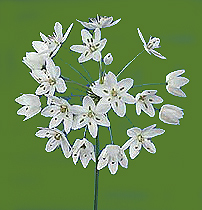
Allium 'Cowanii,' or Allium 'Neapolitanum', (above) has been around since the 18th century. These 16-inch tall, graceful bloomers naturalize quickly. Divide mature clumps in late summer, when they become overcrowded.

Alliums range in height from 6 inches to 4 or 5 feet, depending upon the variety. Rodents can't stand the onion fragrance of these bulbs. And, that's a good thing because this is one bulb that won't double as lunch for the pesky, little critters who patrol my garden.

They're easy to grow and particularly nice for xeric landscapes since they like dry soil, when dormant. Plant Allium 3 times as deep as each bulb is in diameter. Deep planting is important because it keeps the taller plants from drooping under the weight of the flowers.

PS: Ever been stumped on which end is up? Sometimes it's hard to tell top from bottom with strange bulbs. When in doubt, plant bulbs sideways.

Thursday, October 05, 2006

The Layered Look: Spring Bulbs

A condo dweller wrote in, wishing she had a yard in which to plant a drift of tulips. A yard is fun, but...

You can make a colorful splash with one spectacular planter on your balcony.

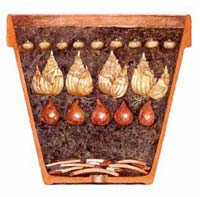
A 20-inch deep pot can hold 3-4 layers of bulbs. Each layer should bloom at a different time.

Container Planting: Layers of Bulbs
  1. Bottom of planter: thin layer of rocks or gravel
  2. Add soil, then first bulb layer: Daffodils
  3. Cover bulbs with soil, add second layer: Early Blooming Tulips
  4. Cover bulbs with soil, add third layer: Hyacinths
  5. Cover with a good bit of soil.
* Press a few Crocus or Grape Hyacinth into top layer of soil. These bulbs, the size of a quarter, put on quite a colorful show.

Tips:
  • Snip foliage away, if you notice the next stage of bloomers is being shaded by the first.
  • Northerners: bubble wrap on the inside of the pots makes great insulation.
  • Get creative on bulb choices. Anything goes!

Tuesday, September 19, 2006

Fall Tulip Bulbs - Tips and Tricks

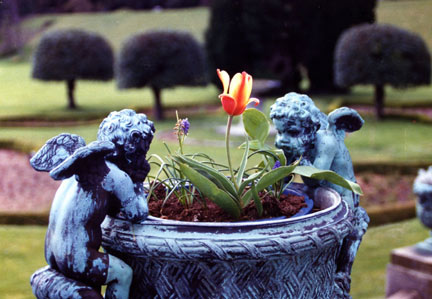
This picture is proof positive I've been a lover of flowers since the dawn of the new age (my new age, that is.) I took it a lifetime ago, while I was wandering aimlessly around Ireland, wondering why my husband was leaving me, of all people.

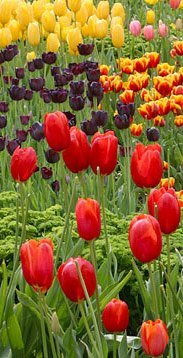
Cool, crisp autumn days have me in the mood to plant some Tulips. This most cheerful reminder of Spring can be timed for a long, blooming show if you plant a combination of early, mid-spring and late-blooming varieties.

The larger the bulb, the larger the flower.
But, look at these photos. I don't have $1,000 to invest in bulbs and the big ones are quite expensive. I'm opting for the cheaper Target varieties to save money. It's true the tulip flowers will be smaller, but a large drift of color is easily affordable.


  • Place in the ground pointed end up.
  • Planting bulbs deeper in the ground helps them stand tall with no drooping.
  • Tulip bulbs have an onion-like, papery skin that is almost always damaged. No worries. The broken 'skin' actually promotes faster rooting, when planted.
  • Place bulbs between groups of later-blooming perennials (such as poppies, iris, and catmint.) As perennials grow tall, they will camouflage dying tulip leaves.
  • Give bulbs a nutrient boost with low nitrogen fertilizer (screened cow manure is great and very inexpensive.)
  • After flowering, remove faded blooms so plants put energy into strengthening the bulb, not producing seeds.
  • Leave foliage in place - that helps bulbs send energy/food to roots for stronger flowering next spring.
Ever wonder why they do so poorly as cut flowers?
Tulips need sunlight to bloom and root energy, too. On average, cut tulips will only survive about 3-4 days. Cut 'em at bud stage to extend their life in the vase.

* Visit Powerscourt Gardens to see where I fell in love with tulips. (Top photo)
** If your husband is leaving you - do what I did! Go here!